- Physics
- ModelClosed-form magnetostatics of the coil and the primary conductor
- Flux linkageSummed over 100 discrete turns, each a small loop in a uniform field
- TolerancesMean and cross-section radius, winding uniformity and conductor offset
- ValidationMatches the textbook mutual-inductance formula exactly, checked before any data was generated
- Role of ML
- Tolerance studies need thousands of Monte Carlo samples, and a Maxwell FEM solve per sample doesn't scale. The surrogate, trained on 512 physics evaluations, makes the study live and reports how confident each prediction is.
Background
A Rogowski coil's transfer function, its mutual inductance, depends on geometry that is never manufactured perfectly: the mean coil radius, the cross-section radius, the winding uniformity and how well the primary conductor is centred. Tolerances on each of these shift the transfer function away from its nominal calibration, and the IEC 61869-10 accuracy classes set how far it may drift before units are no longer interchangeable without individual recalibration. A proper Monte Carlo study of this five-parameter tolerance space needs thousands of evaluations, far more than one field solve at a time allows. This project makes that study interactive, using the same architecture as the CT tamper-immunity project on different physics.
Approach
The physics is a closed-form magnetostatic model of the coil: 100 discrete turns, each treated as a small loop in a uniform field, summed around the coil. It was validated against the textbook mutual-inductance formula before any data was generated. A 512-point scrambled-Sobol design of experiments followed (445 for training, 67 held out). The conductor offset is sampled on a disk rather than a square, so every sample is physically inside the coil aperture. FLAML AutoML again selected LightGBM, wrapped in a 25-member bootstrap ensemble with calibrated uncertainty.
Process
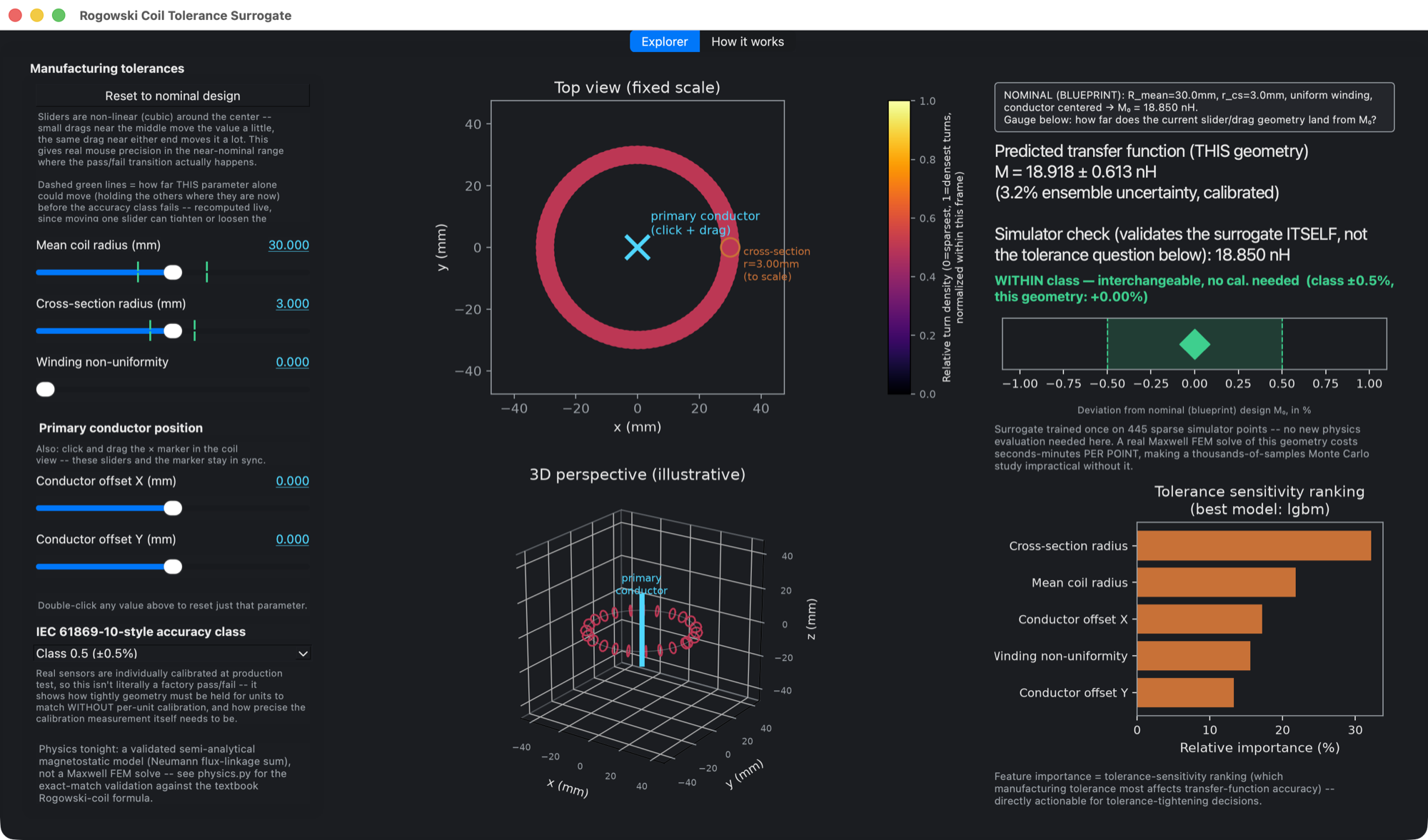
The ensemble's uncertainty was checked against held-out data rather than assumed. Its raw 1-sigma coverage was 77.6 %, and a single calibration factor of 0.79, chosen on validation data, brings it to the correct 68.27 %. The accuracy-class gauge is also framed carefully: it measures geometric deviation from a shared nominal design, not whether a particular unit would fail inspection. Real units are individually calibrated at production test, and the tool is deliberately kept to what the physics supports.
Results
- Held-out relative RMSE of 1.92 % (LightGBM).
- A live desktop app: drag any of the five tolerance parameters, or drag the conductor directly on the coil cross-section, and see the predicted transfer function, its calibrated uncertainty and whether the design stays inside the chosen IEC accuracy class, instantly rather than one field solve per point.
- A tolerance-sensitivity ranking, led by the cross-section radius and the mean coil radius, that shows which manufacturing tolerance to tighten first.
- This project and the CT tamper-immunity study formed the basis of a talk at the CADFEM World Conference 2026, with the explorer screenshots and sensitivity charts used directly in the presentation.
Live demo
Screen recording of the packaged app: dragging tolerance sliders and the conductor position, and watching the predicted transfer function and accuracy-class verdict respond in real time.